How We Work
SVQF’s work focuses on helping eradicate extreme poverty, which the UN and World Bank define as living on less than US $1.25 per day. According to economist Jeffrey Sachs, extreme poverty is the inability to meet basic needs such as adequatenutrition, access to safe water, access to basic education, access to primary health services, and alivelihood that can generate an income to meet thesebasic needs. By eitherdefinition about 1 billion people worldwide currently live in extreme poverty.
FUNDING
SVQF is not a fully funded organization and must raise funds to carry out its programs. We have instituted strict stewardship of donor funds and adhere to high standards of transparency. SVQF does not hold funds long term in its accounts and releases all funds to projects at least once a year.
PARTNERSHIPS
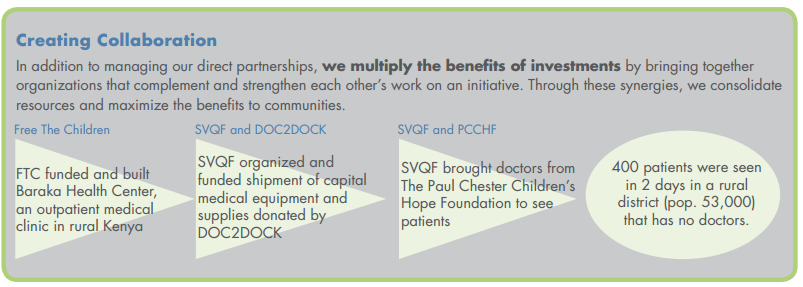
- We bring together reputable, expert organizations to leverage synergies and maximize impact.
- We work with partner organizations to cultivate active community and stakeholder involvement and ownership of projects.
- We align ourselves with organizations that share our belief in practical targeted efforts yielding measurable results in the eradication of extreme poverty.
- We require our non-profit implementing partners to be non-partisan, reputable, and experienced 501(c)3 organizations with ground-level knowledge and local contacts.
INITIATIVES
SVQF invests in programs with focused agendas that address the root causes of extreme poverty. We require regular and detailed reports from our partners on the initiative’s progress and results.
The initiatives must meet the following criteria:
Tangible Results: Traditionally, philanthropy was measured and defined by the amount of money raised or applied to a problem. SVQF instead takes an investor-oriented approach that focuses on the use of the funds and its concrete social impact.
Community Involvement: The initiatives are not imposed upon communities. In each case, the community itself is actively involved in seeking, supporting, and sustaining the initiative.
Sustainability: SVQF seeks to create lasting and sustainable improvements, not quick fixes. The beneficiary community takes ultimate responsibility for independently maintaining the progress made.
Replicability: The initiatives can be replicated in another community or another country.
Scalability: An initiative effective for a community of 100 inhabitants should be capable of being scaled up to serve a community of 10,000 inhabitants.
